




November is Diabetes Awareness month and November 14th is World Diabetes Day. This is an important opportunity to reflect on where we stand with diabetes treatment and care and encourage friends, family, organizations, and governments to become better informed and take action.
Type 1 diabetes (T1D) is a lifelong illness that requires treatment with insulin. Once known as a “juvenile” disease, T1D is increasingly found in adults. A similar but slower progressing diabetes called latent autoimmune diabetes in adults (LADA) is becoming better understood. Regardless of the type, diabetes can look very different and its management is not a one size fits all.
T1D is a worldwide issue
589 million people are living with diabetes across the world, including more than 9.5 million living with T1D. In Canada, over 250 000 people are living with T1D and, by 2040, that number is expected to climb to 350 000. Major progress is happening to identify people at risk before a typical diagnosis at the emergency ward, to help the management of T1D, as well as some important progress toward a cure.
To support this growing population, some basics are absolutely necessary:
- Having the right diagnosis
- Having access to technology and medication
- Having access to comprehensive care and education
Screening and diagnosis of T1D
T1D in adults and LADA are often misdiagnosed as type 2 diabetes. This can mean months or years of worsening health, confusion, and frustration. Strategies increasingly used to screen for T1D, like autoantibody and genetic testing, as well as surrogate measures of your body’s ability to produce insulin (c-peptide levels) can help lead to the correct diagnosis.
Screening can also identify people who are likely to develop T1D before they experience the symptoms. Being aware and prepared for symptoms that come with the onset of T1D can help to avoid the most serious complications (diabetic ketoacidosis) and hospitalisation otherwise common at diagnosis. The initial target population for screening is the relatives of people living with T1D (e.g., FEDERATE T1D program), but screening should expand with time to other groups including people living with another autoimmune disease.
Although screening programs in Canada are in the early stages of development, preparing to support a population who screen positive for T1D is a high priority. Both educational resources to prepare for the reality of living with T1D and affordable access to medication to slow T1D onset are key to getting to most benefits out of screening. Currently Teplizumab, the only drug approved to slow the progression, is approved in Canada but not covered by public insurance.
Access to technological advances
Across the globe, access to and coverage for essential items like glucose meters and insulin is extremely varied. Scarcity of these resources is associated with worse blood sugar outcomes and fewer years in good health. Even in Canada, access to some technology (e.g., continuous glucose monitoring systems or artificial pancreas) can be limited. In Quebec, where insulin pumps are only covered by the public provincial program for those under 18, advocacy efforts to provide coverage for insulin pumps for adults are ongoing.
In the BETTER registry, we see that adoption of technology is high, and glucose management is improving (e.g., lower HbA1c and less hypoglycemic episodes), but the mental burden of T1D is a persistent issue. This highlights the serious need for mental health care and greater leaps in technology to remove the excessive burdens, understandable fears, and stresses that come with acting as your own pancreas while going about your day. Technological advances despite all their benefits also come with new issues such as higher costs and increased visibility of T1D.
What’s up and coming?
This year, more data and recommendations have emerged on the use of new medications in addition to insulin (aka adjuvant or adjunct therapies, e.g., Mounjaro, Ozempic) to help manage T1D, opening up new strategies to manage blood sugar based on your situation.
Countless research studies on T1D are ongoing, from the development of new technology (fully automated insulin delivery, longer lasting continuous glucose monitors, implantable glucagon), to better medications and exercise strategies, and improved islet transplantation including options without immune suppression. Yet, until there is a cure, every day living with T1D remains a persistent, mostly individual challenge.
Finding support and community
Though T1D management strategies for glucose monitoring and insulin administration are necessary, so is taking care of one’s mental, social, and emotional health to avoid burnout and diabetes distress. The T1D community, across organizations, social media, and in person events can be an amazing resource to feel less alone and connect with others. The BETTER project is both a resource for data on the lived experience of T1D and a hub for evidence-based research and care information.
This world diabetes day, consider adding your or your child’s lived experiences with T1D or LADA to the BETTER registry.
References:
- Type 1 Diabetes index: https://www.t1dindex.org/
- World Diabetes Day https://worlddiabetesday.org/
- Holt RIG, DeVries JH, Hess-Fischl A, Hirsch IB, Kirkman MS, Klupa T, Ludwig B, Nørgaard K, Pettus J, Renard E, Skyler JS, Snoek FJ, Weinstock RS, Peters AL. The management of type 1 diabetes in adults. The updated 2026 consensus report by the American Diabetes Association (ADA) and the European Association for the Study of Diabetes (EASD). Diabetologia. 2026 Sep 16. doi: 10.1007/s00125-026-06833-z. Epub ahead of print. Erratum in: Diabetologia. 2026 Sep 30. doi: 10.1007/s00125-026-06893-1. PMID: 42747450.

Written by: Cassandra Locatelli, PhD
Reviewed by:
- Remi Rabasa-Lhoret, MD, PhD
- Jane Yardley, PhD
- Anna Theroux, Pamela Dawe, patient partners

Walking, cardio, and strength training with type 1 diabetes : less highs, more lows
Optimizing your artificial pancreas: Omnipod 5
Should an artificial pancreas be used in pregnancy with type 1 diabetes?
Sign up for our newsletter
Subscribe to stay informed about type 1 diabetes.
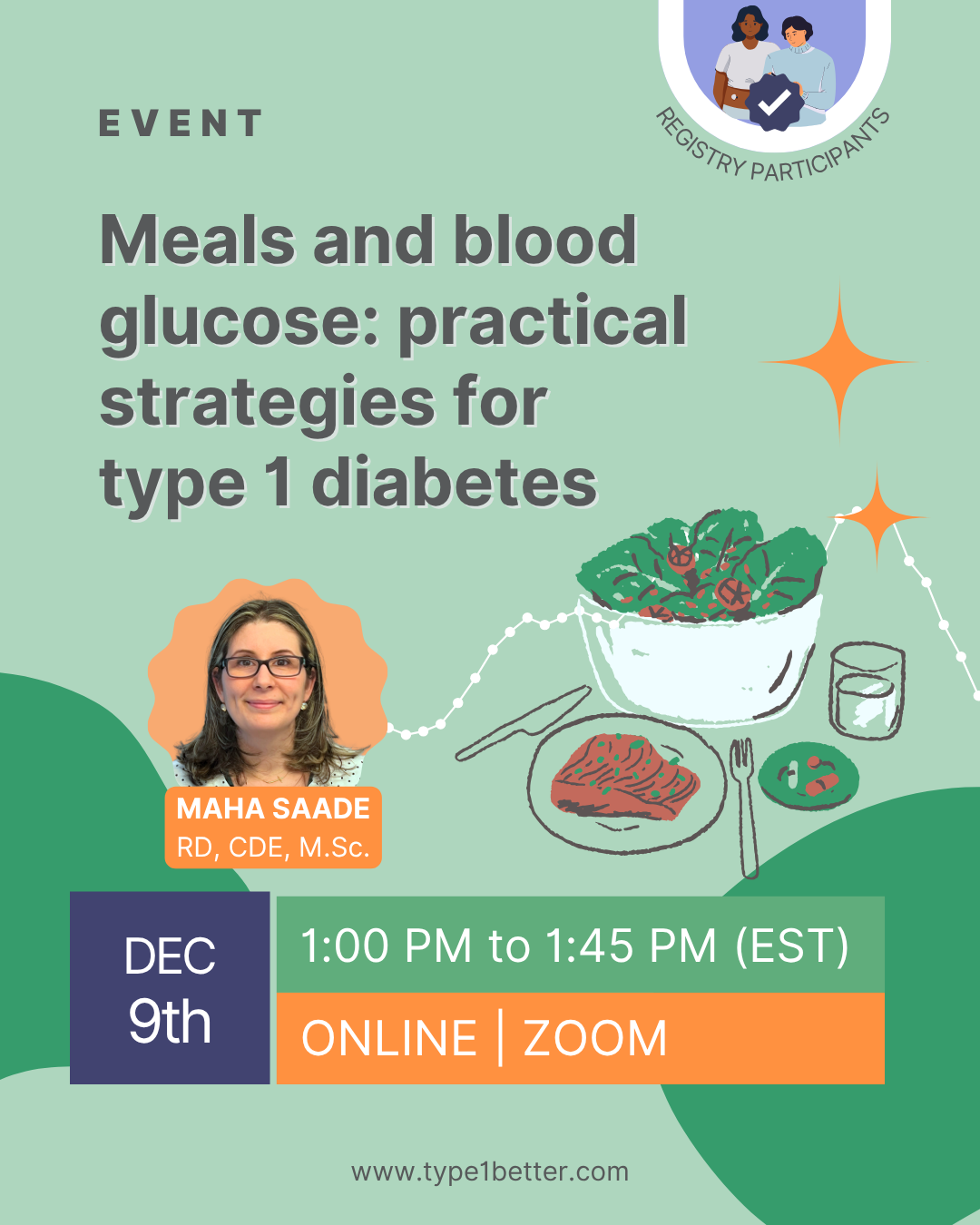
Upcoming Event
Participate in the BETTER registry!

First registry of people living with T1D in Canada.
Learn More