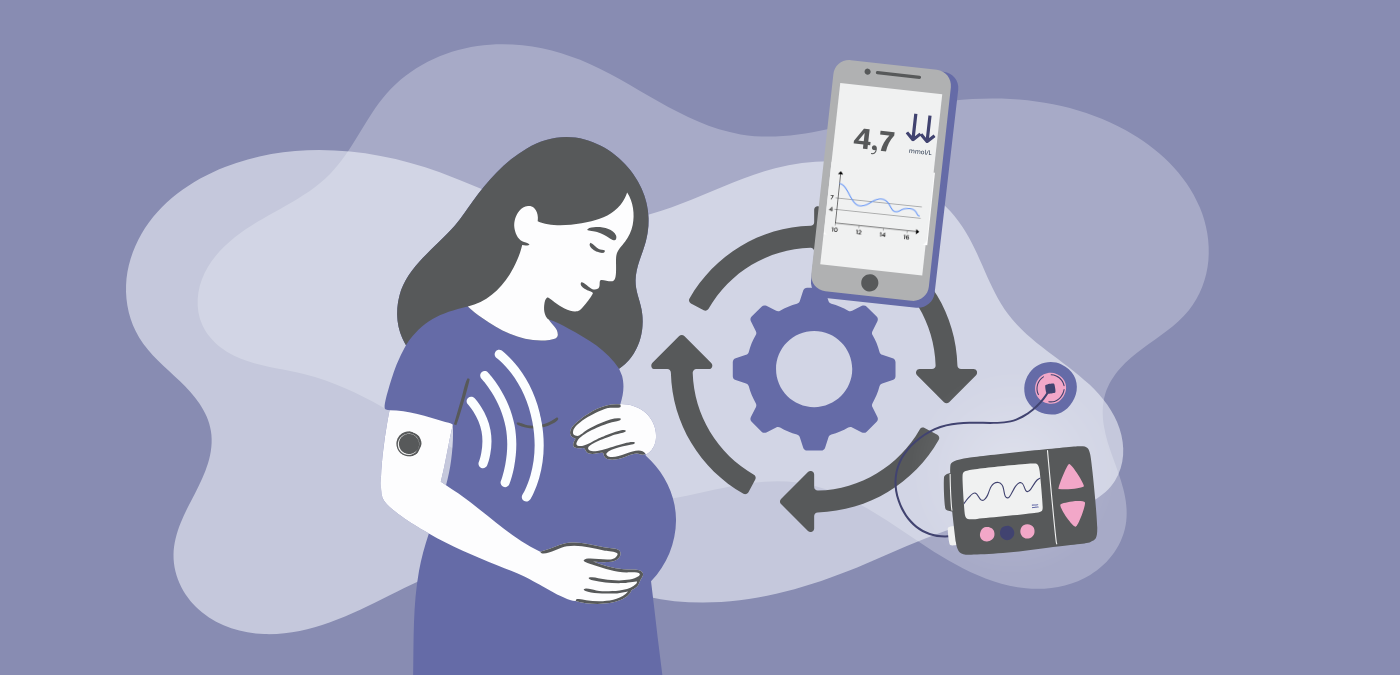
Pregnancy is a time of anticipation, excitement and change. Frustratingly, blood sugar levels also change significantly during pregnancy: hypoglycemia is more likely, insulin resistance increases, and insulin doses need constant adjustments. Even the recommended optimal glucose range is adjusted in pregnancy (3.5-7.8 mmol/L) compared to typical recommendations (3.9-10 mmol/L) to lower the risk for complications like preterm birth and preeclampsia.
Automated insulin delivery improves time in range, but for who?
Artificial pancreases, also called automated insulin delivery (AID) or hybrid closed loop systems, are increasingly used and recommended for T1D management. AID systems include an insulin pump, connected continuous glucose monitor (CGM), and an algorithm to link the two. Current recommendations for AID include children as young as two, and AID may be also helpful for post-partum mothers. These systems can lower management burden (e.g., give correction insulin automatically, reduce insulin when blood glucose is trending low) and improve blood sugar numbers in other groups of people, but the evidence during pregnancy is just now catching up.
Testing AID during pregnancy
A 2025 study recruited pregnant women living with T1D in Canada and Australia and randomly assigned them to AID using the Tandem t:slim Control IQ system or their typical insulin delivery (insulin pump or multiple daily insulin injections). A total of 88 women were included in the study and they were followed through weeks 16 to 34 of pregnancy.
AID users spent more time in target range
In the AID group, participants’ time in pregnancy-specific range (3.5-7.8 mmol/L) increased by 11% over weeks 16 to 34 of pregnancy, compared to just 2.5% in the control group. In particular, time in range was most improved overnight to early morning and these changes were seen almost immediately after beginning AID use.
Sleep quality was improved among pregnant AID users
Overall sleep quality from baseline to week 24 was improved for AID users and unchanged or slightly worse for the control group. Expectedly, sleep quality was poorer for everyone by week 34 of pregnancy.
There were seven AID-specific incidents including skin reactions at the pump site or leaky tubes, but none of these resulted in a serious adverse event.
A tool at your disposal
This study adds to the evidence that AID systems can be beneficial in pregnancy, especially for stabilized blood sugar overnight, and it led to the FDA approval of this system in pregnancy. In this study, participants were randomly assigned to use AID early in pregnancy; however, if they were able to choose the system and start using it prior to pregnancy, this could reduce the need to learn and adjust to new technology during a period of significant emotional and physical change. All new technology comes with a learning curve; speak to your healthcare providers if you are interested in adding technology to your T1D management toolkit.
Do you live with T1D and want to share your lived experience? Consider joining the BETTER registry today!
Reference:
Donovan LE, Lemieux P, Dunlop AD, Yamamoto JM, Murphy HR, Simmons D, Bell RC, Chaput KH, Benham JL, Ross GP, Nerenberg KA, Booth JE, Perkins BA, Mohammad K, Ntanda HN, King JA, Tomlinson G, Feig DS; CIRCUIT Collaborative Group. Closed-Loop Insulin Delivery in Type 1 Diabetes in Pregnancy: The CIRCUIT Randomized Clinical Trial. JAMA. 2025 Dec 23;334(24):2176-2185. doi: 10.1001/jama.2025.19578. PMID: 41134589; PMCID: PMC12553030.