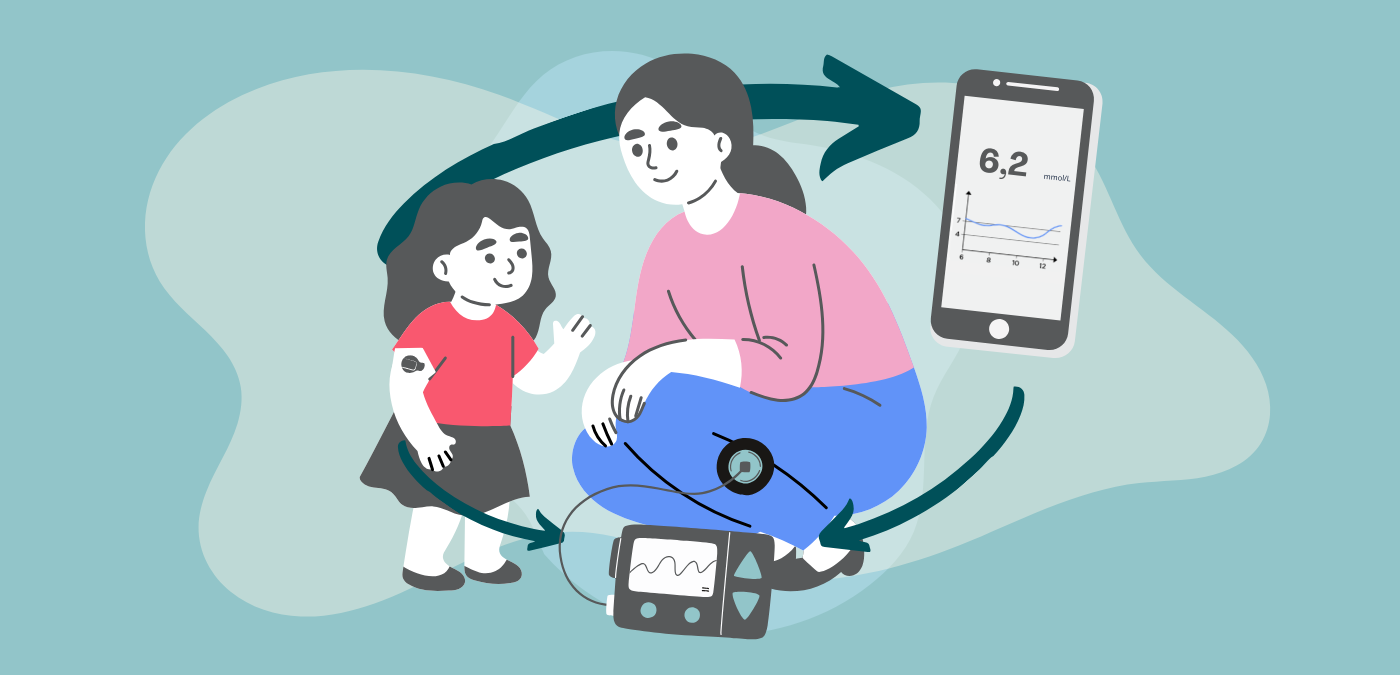
Automated insulin delivery systems are now commercially available and increasingly used among people living with type 1 diabetes (T1D). These systems, also known as “hybrid closed loop” or “artificial pancreas”, mean that the insulin pump is automatically adjusting the insulin administration depending on continuous glucose monitor (CGM) data and an algorithm. The systems are not fully automated however, because bolus calculations must be inputted before meals and other adjustments may be needed (e.g. for physical activity).
T1D is challenging to manage at any age, but even more so in young children. Parents and caregivers of these kids often experience poor sleep quality and significant fears for their child experiencing hypoglycemia. While automating insulin delivery for kids sounds enticing, testing for feasibility including safety (hypoglycemia risk) and efficacy (glucose time in range) is necessary. Currently, few systems have been tested in kids below 6 years of age.
Can automated systems work for young kids?
A recent study used a commercially available hybrid closed loop system in 98 children aged 2 to 6. To be included, children needed to be using at least 6 units of insulin per day. Participants used the same insulin pump and sensor /CGM , alternating between a manual mode (with a low-glucose suspend feature in which the pump infusion is suspended in case of hypoglycemia) and an automatic (hybrid closed-loop) mode, each for 12 weeks. At the start of the trial, participants had a 2-week “run-in” phase using the system in manual mode to make sure they could tolerate its use. During this phase, baseline measurements were taken and then participants were randomly assigned which mode, manual or automatic, was used first.
Improved glycemia for young kids using closed loops
When the kids were using the auto mode, their HbA1c was 0.6% lower than when using the manual. Average time in range glucose (3.9 to 10 mmol/L) was also 10% greater on auto mode compared to both the start of the trial and the manual mode periods (58% to 68%). Most of the improved time in range was considered in “tight range” with glycemia 3.9 – 7.8 mmol/L.
However, auto mode resulted in slightly more time below range (3.0 to 3.9 mmol/L).
No severe hypoglycemic episodes
No severe hypoglycemia occurred during the study and participants spent less than 1% of time with glucose levels below 3.0 mmol/L. One participant experienced a ketoacidosis event which was related to a viral infection.
Families might benefit from closed loops for kids
Parental concerns about hypoglycemia remained stable throughout the study, suggesting that use of the automated system did not increase anxiety. In parents and caregivers, sleep quality was slightly better during the automated phase and nearly reached defined “good sleep quality” levels.
Closed loops for all?
This study provides further evidence that automatic, closed-loop insulin pump systems could be beneficial for an even wider range of people with T1D. Future studies should investigate long-term effects on children’s self image, independence, and diabetes management skills, as well as the continued impacts or benefits on caregivers’ and families’ well-being.
Closed-loop systems that have been studied in kids >2 years thus far:
This study used: MiniMed 780G + Guardian 4 CGM (Medtronic)
Another study used: Omnipod 5 + Dexcom 6 CGM
Reference:
Battelino T, Kuusela S, Shetty A, Rabbone I, Cherubini V, Campbell F, Ahomäki R, Tuomaala AK, Peters C, Iafusco D, Sundaram P, Schiaffini R, Cellot J, Gulotta F, Di Piazza F, Cohen O; LENNY study group. Efficacy and safety of automated insulin delivery in children aged 2-6 years (LENNY): an open-label, multicentre, randomised, crossover trial. Lancet Diabetes Endocrinol. 2025 Aug;13(8):662-673. doi: 10.1016/S2213-8587(25)00091-9. Epub 2025 Jun 19. PMID: 40544853.
Related interview:
MiniMed 780G safe and effective for children 2-6 years with type 1 diabetes – touchENDOCRINOLOGY