




Every year, the International Society for Pediatric and Adolescent Diabetes (ISPAD) Congress brings together leading experts in type 1 diabetes (T1D) care for children, adolescents, and young adults. Researchers, clinicians, and people living with diabetes gather to share the latest discoveries and promising innovations.
At the 2025 edition, held last November in Montreal, several presentations particularly caught our attention, ranging from technological advances to new clinical data and initiatives aimed at improving quality of life. We have selected and summarized a few key sessions that we found especially relevant and hopeful for people living with T1D and their families.
Continuous ketone monitoring to better prevent diabetic ketoacidosis
Abbott has developed a small sensor capable of continuously measuring both glucose and ketones. Ketones are molecules that appear when the body lacks insulin and begins to burn fat for energy. If ketones accumulate excessively, they can lead to diabetic ketoacidosis (DKA), a serious medical emergency.
High blood glucose alone does not necessarily indicate elevated ketones, and conversely, normal or moderately high glucose levels do not guarantee the absence of ketones.
Studies presented by Dr. Jennifer L. Sherr (USA) showed that in people using insulin pumps, ketones can rise in less than six hours during insulin interruption—sometimes before glucose levels increase—a previously underrecognized phenomenon. Beyond the ability to detect ketones quickly, identify their cause, and take action to reduce them, these sensors will also help better understand daily ketone fluctuations in relation to stress, meals, sleep, or missed insulin doses.
Researchers emphasize that the market introduction of continuous ketone monitors should come with practical, clear guidelines so that the new data generated help, rather than increase, the mental burden of T1D management.
Tighter glucose targets… but not without support
With the proven benefits of current technologies such as continuous glucose monitors and hybrid closed-loop systems (also called “artificial pancreas”) in T1D management, the question arises: can—and should—we aim for stricter glucose targets?
Data presented by Professor Karin Åkesson (Sweden) show that the introduction of continuous glucose monitoring and carbohydrate counting from diagnosis improves T1D management. These benefits were primarily measured by a reduction in HbA1c in the months following diagnosis, without an increase in severe hypoglycemia.
However, Janie Bédard (Canada), who lives with T1D, reminded the audience that glucose targets can turn diabetes management into a “performance duty.” For children and parents alike, this can increase mental burden, create a sense of failure when values fall outside the target range, and complicate daily life. Any consideration of tighter glycemic targets must therefore come with strong psychological support and an approach that values lived experience as much as numbers.
Artificial intelligence and closed-loop systems: toward automated meal management
Even with the latest hybrid closed-loop systems, users are still required to calculate and enter their carbohydrate intake to the insulin pump. This demands knowledge and time, and calculations are often imprecise.
Professor Marc D. Breton (USA) presented promising research on the use of digital twins—a virtual version of a person created from their own data. This “double” allows safe exploration of how the body responds to various changes (meals, stress, insulin, etc.). Using this approach, artificial intelligence can suggest optimal pump adjustments to personalize treatment.
He is also developing a “fully closed-loop” system capable of detecting a meal automatically, without the user having to announce it. Continuous glucose monitoring detects early glucose rises, and the algorithm responds by delivering an appropriate insulin bolus. Early results show improved time in range compared with current systems, offering hope that further automation could reduce calculations, decisions, and mental burden for people with diabetes.
The DIY movement: people with T1D driving innovation
One session, presented by Marie-Laurence Brunet (Canada) and Lenka Petruzelková (Czech Republic), highlighted so-called “Do-It-Yourself” (DIY) closed-loop systems—insulin automation solutions created by people living with T1D and their loved ones, long before the industry stepped in.
The session emphasized how Loop, AndroidAPS, and OpenAPS have transformed thousands of lives worldwide: more time in range, fewer hypoglycemic episodes, and, most importantly, reduced mental burden thanks to highly personalized settings that commercial hybrid closed-loop systems (e.g., Omnipod, Medtronic, Tandem, Ypsomed) still cannot match.
Speakers also noted that despite continuous market release of new systems, DIY remains essential: it continues to innovate, address complex needs (exercise, hormones, irregular schedules), and inspire features now incorporated into commercial systems. The session also highlighted the crucial role of healthcare professionals in supporting, safeguarding, and acknowledging patients using DIY systems rather than ignoring them.
In short, the takeaway is simple: when people living with T1D are given space, innovation progresses faster and further.
Hypoglycemia: a universal challenge
How can we better prevent and manage hypoglycemia worldwide? This session brought together perspectives from the UK, Canada, and Pakistan.
Dr. Catherine Russon (UK) emphasized that despite technological advances, fear of hypoglycemia remains a major barrier to physical activity and quality of life. Her team is developing an AI-based tool to predict hypoglycemia risk during exercise by combining data such as starting glucose, active insulin, and exercise type. The goal is to provide clear guidance and help people with T1D feel safer while being active.
Professor Anne-Sophie Brazeau (Canada) presented data from the BETTER registry, documenting the frequency, triggers, and real-world impacts of hypoglycemia. Supported by patient partners, the registry helps understand needs and co-create practical solutions, such as the Support platform for daily T1D management.
Dr. Fauzia Moyeen (Pakistan) shared striking insights from low-resource settings, where glucagon is often unavailable to treat severe hypoglycemia. Although international clinical guidelines do not provide alternatives for severe hypoglycemia, families improvise, e.g., rubbing honey on the gums.
Despite differing contexts, the message is consistent: hypoglycemia must be better prevented and understood, and people living with T1D must be better equipped to manage it globally.
When patients speak and transform research
Every day at the conference, sessions highlighted voices of those directly affected by T1D worldwide. They shared their stories, challenges, and strategies, reminding everyone that research only matters if it truly addresses patients’ needs. They discussed stigma, mental burden, daily frustrations, and the importance of building bridges between patients and healthcare professionals.
The message was clear: it is not enough to listen to people living with diabetes; we must work with them, co-design research projects, and co-decide priorities.
Initiatives like De Doc exemplify this approach. This international community, created by and for people with diabetes, connects patients, families, and healthcare professionals. Through programs, conference scholarships, and symposia, patients can share experiences, influence research, raise awareness, and participate in policy decisions. Advocacy takes its full meaning here: #NothingAboutUsWithoutUs, as lived experience guides science to tangibly improve daily life.
To summarize
The 2025 ISPAD Congress offered a message of hope: with appropriate tools and human and psychological support, T1D management and quality of life can improve. However, many accessibility challenges remain worldwide to ensure all people with diabetes have access to the treatments and technologies they need.
Collaboration between healthcare professionals, researchers, and people living with diabetes is essential to understand real-world needs and find solutions that make daily life better everywhere.
The BETTER registry concretely aims to better understand the needs of people living with T1D in Canada and co-create tailored solutions. If you, or your child, live with type 1 diabetes (or LADA) in Canada, you can participate now to make your voice heard.
References
- Sherr, J. L. (2025, Nov 7). HL‑01 Evolution of Glucose and Ketone Levels during Insulin Deprivation in Youth with T1D during an Assessment of a Continuous Dual Glucose Ketone Sensor [Presentation]. ISPAD 2025, New Haven, USA.
- Breton, M. D. (2025, Nov 7). Leveraging AI in Insulin Dosing: the Next Frontier of Automated Insulin Delivery and Diabetes Management [Presentation]. ISPAD 2025, Center for Diabetes Technology, University of Virginia, Charlottesville, USA.
- ISPAD‑ATTD Joint Symposium. (2025, Nov 5). Real-world use of technology [Symposium]. ISPAD 2025, Session Hall 1, Lisbon, Portugal. Speakers: Karin Åkesson, Janie Bédard, Roque Cardona-Hernandez.
- Addala, A., & Dzikiti, T. (Chairs). (2025, Nov 8). Are we ready to introduce DIY to a broader audience? [Workshop]. ISPAD 2025, Session Hall 3, Lisbon, Portugal. Speakers: Marie-Laurence Brunet, Lenka Petruzelkova.
- Kichler, J., & Klatman, E. (Chairs). (2025, Nov 6). Advocacy meets Science: The Advocate’s Role in Advancing Diabetes Research with Patient-Centric Insights [Symposium]. ISPAD 2025, Workshop Room, Lisbon, Portugal. Speakers: Asra Ahmed, Dana Greenberg, Renza Scibilia.
- Hauck, B., & Scibilia, R. (Chairs). (2025, Nov 6). #dedoc: Advancing Diabetes Care in Complex Settings: Evidence, Experience, and Advocacy: What we wish you knew and why [Side Event]. ISPAD 2025, Session Hall 3, Lisbon, Portugal. Speakers: Bastian Hauck, Fergus Cameron, Linxi Mytkolli, Apoorva Gomber, Jérôme Kazabukeye, Paul-Louis Fouesnant.

Written by : Sarah Haag, RN, B.Sc.
Reviewed by :
- Amelie Roy-Fleming, RD, CDE, M.Sc.
- Anne-Sophie Brazeau, RD, PhD



Sign up for our newsletter
Subscribe to stay informed about type 1 diabetes.
Upcoming Event
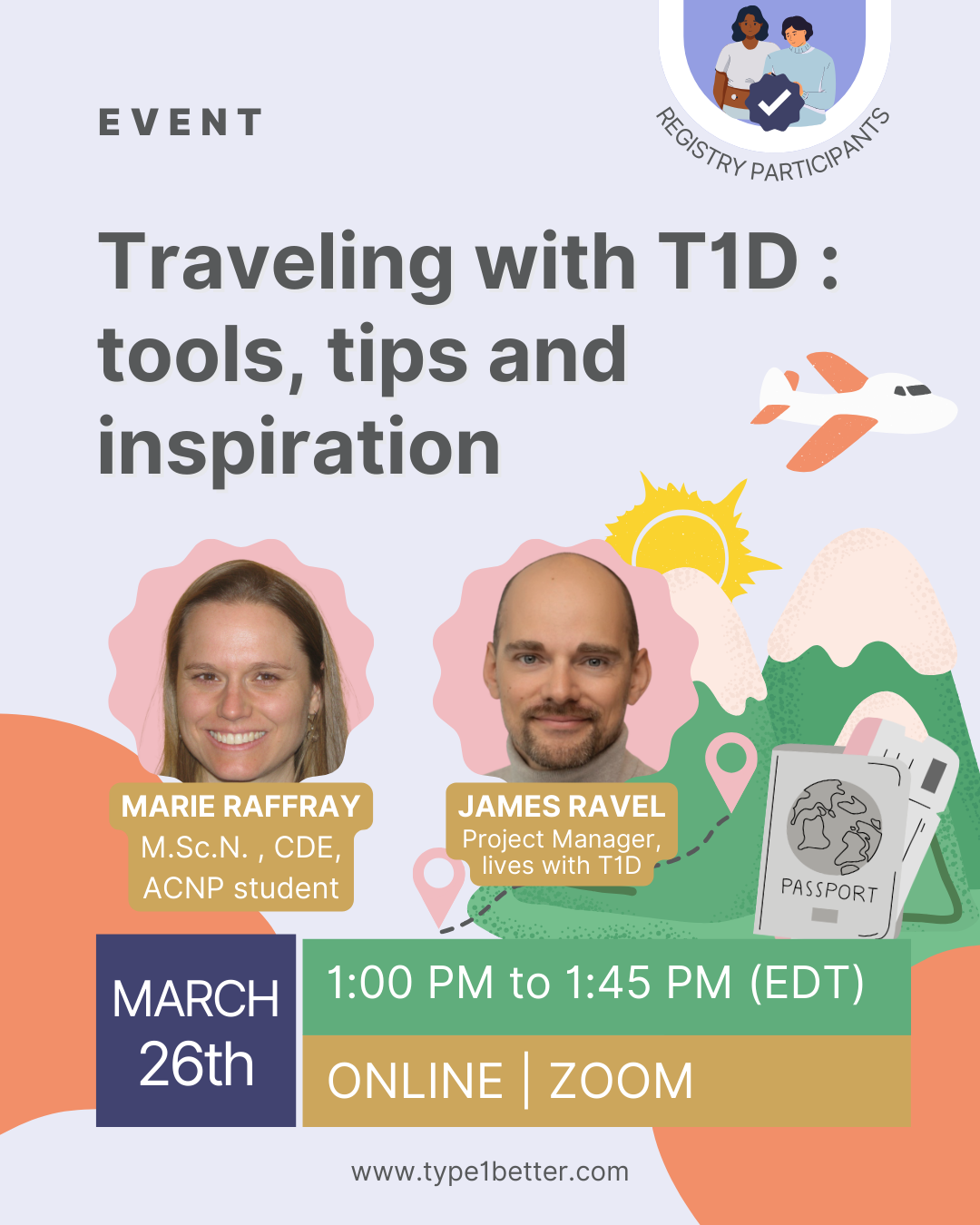
Participate in the BETTER registry!

First registry of people living with T1D in Canada.
Learn More