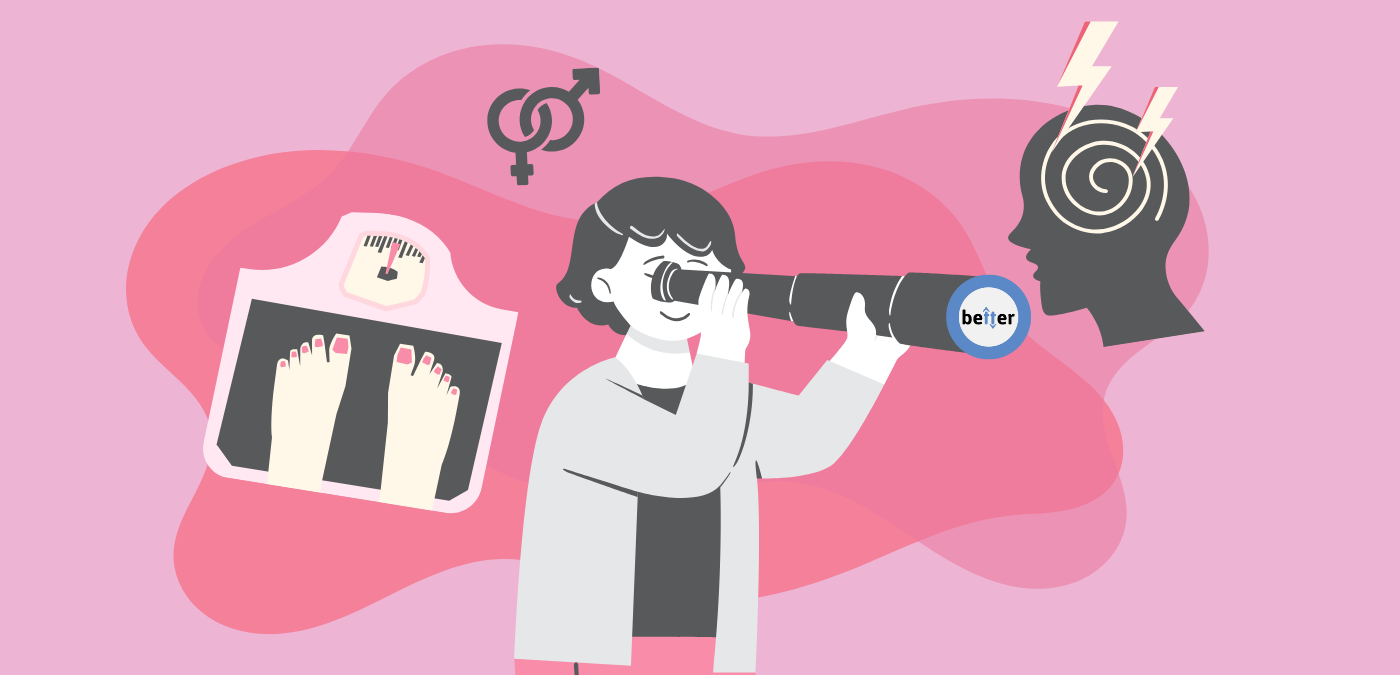
Living with type 1 diabetes (T1D) means juggling a lot: insulin doses, blood sugar checks, carb counts, exercise, and more. These things bring a serious mental load, and research has shown that people with T1D are more likely to experience mental health struggles than the general population. Researchers have also found that women tend to report more mental health challenges than men. But there are other layers we don’t always talk about: how can things like body weight affect mental health?
We recently looked at this issue using data from over 1,000 adults living with T1D who have participated in the BETTER registry. Our focus? Understanding how weight and gender are connected to feelings like diabetes-related distress and stigma, depression, and fear of low blood sugar (hypoglycemia).
What we wanted to know
How does weight come into play with mental health in people living with T1D? Does a higher weight make mental health challenges worse—and does it affect women and men differently?
What we found
For this study, we grouped participants by body mass index (BMI), a simple calculation based on a person’s height and weight that gives an estimate of whether someone falls into a lower, middle, or higher weight category: under 25 kg/m2 (lower weight), 25 to 29.9 kg/m2 (middle weight), and 30 kg/m2 or more (higher weight).
We found that women in the higher weight category were more likely to report symptoms of depression and anxiety, and to feel more distressed about managing their diabetes compared to women in lower weight categories. They also felt more judged and blamed because of their diabetes, a type of stigma that can be especially hard to deal with when it’s connected to weight.
In contrast, men didn’t report any differences across weight groups. However, when comparing men and women, a standout finding was that men with a weight in the middle category were more likely to report a strong fear of hypoglycemia. This is surprising, since past studies have shown that women usually report more fear of low blood sugar.
Why does this matter?
These results show us that mental health support for people with T1D shouldn’t be one-size-fits-all. Women with higher weight may need more targeted support to help manage feelings of stigma, distress, and low mood. Meanwhile, understanding the reasons behind a strong fear of hypoglycemia in men in the middle weight category might help guide better care strategies. It’s also worth noting that the lack of differences across weight groups in men might reflect underreporting of mental health challenges due to societal norms and stigma.
The goal is not to label or judge anyone based on their weight or gender, but to understand their lived experiences better so that care can be more personalized and compassionate.
What’s next?
There’s still a lot to learn. Our study included mostly white participants and didn’t include non-binary people due to small numbers in the registry. Future studies should explore how race, ethnicity, and gender diversity affect these relationships.
In addition, while our study used BMI to group participants, it’s important to recognize that BMI isn’t a perfect measure. It doesn’t distinguish between fat and muscle, and it doesn’t capture how weight is distributed across the body. For example, someone with a lot of muscle might have a high BMI without having excess fat. In future research, using tools such as body composition measurements and waist circumference would be good alternatives. The goal is not to manage weight; rather, it’s to improve physical and mental health issues, and in many situations, this can be accomplished without trying to lose weight.
For now, this research helps us better understand a complex but important reality: weight and gender both shape how people experience life with T1D, and that includes their mental well-being.
Reference:
Bonhoure, A., Lalanne-Mistrih, M.-L., Talbo, M., Boudreau, V., Messier, V., Bandini, A., Secours, L., Fontaine, S., Brazeau, A.-S., & Rabasa-Lhoret, R. (2025). Gender differences in psychosocial outcomes according to BMI among adults living with type 1 diabetes: a cross-sectional BETTER analysis. Journal of Clinical and Translational Endocrinology, 31, 100383. https://doi.org/10.1016/j.jcte.2025.100383